The Internal
Travel Portal Hub
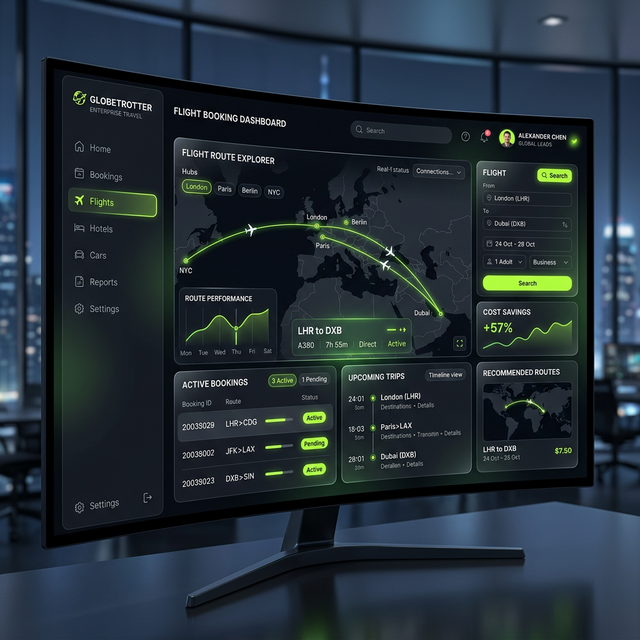
Solving the complexity of enterprise travel requests through a unified request hub that optimizes employee workflows.
Summary
A complete overhaul of the employee travel experience. We moved it from a complex ticket-based system to a guided, self-service portal, drastically reducing the time spent by employees on travel logistics.
Booking Time
-55%Policy Compliance
98%Support Tickets
-40%The Problem
Corporate travel booking was a fragmented, frustrating process involving multiple third-party sites, endless email chains for manager approvals, and manual expense reporting. Employees dreaded booking business trips, and the finance department struggled with out-of-policy spending.
Fragmented Workflow
Booking flights, hotels, and cars required visiting three separate vendor websites.
Approval Bottlenecks
Email-based approvals took days, during which flight prices often spiked.
Policy Confusion
Employees didn't know the exact budget limits for different cities, leading to frequent compliance violations.
Why it started?
As the company scaled globally, the old "email the travel agent" method collapsed under the sheer volume of requests. Finance needed stricter controls, while employees needed a consumer-grade booking experience.
How are we solving it?
By building a centralized, self-service portal. It acts like a modern OTA (Online Travel Agency) but comes pre-loaded with enterprise logic—automatically filtering out non-compliant options and automating approvals via Slack.
Users and Research
We interviewed frequent flyers (sales reps, executives) and travel coordinators. Employees prioritized speed and mobile accessibility for on-the-go changes, while administrators prioritized clear visibility into budget compliance and policy enforcement.
Research Approach
Journey mapping a typical 'Sales Trip'—from the initial client meeting request to the final expense reimbursement two months later.
Core Opportunity
Intercepting policy violations *before* booking occurs, rather than punishing employees during the expense reporting phase.
Frustrations and Findings
The biggest friction point was the approval bottleneck. A flight could increase in price by 20% while waiting for a manager's signature. Furthermore, employees found it difficult to decipher which flight classes or hotels were actually within company policy.
Design Concept
We envisioned a consumer-grade booking experience (like Airbnb or Skyscanner) wrapped in enterprise logic. The UI would dynamically filter out non-compliant options and feature an automated, real-time approval workflow.

Smart Trip Builder
A unified flow for flights, hotels, and transit.
- Dynamic policy badging (e.g., 'Within Budget', 'Requires VP Approval').
- Auto-suggests hotels near the destination office.
- Integration with corporate virtual credit cards to eliminate out-of-pocket expenses.
Slack Integration
Removing the email bottleneck.
- Instant notifications to managers when a booking exceeds standard policy.
- One-click 'Approve' or 'Deny' buttons directly within the Slack UI.
- Automated nudges if an approval sits pending for more than 4 hours.
User Testing
Initial testing showed users loved the interface, but missed the ability to easily bundle flights and hotels. We iterated to introduce a 'Smart Trip' wizard that suggests hotels near the selected destination office automatically after a flight is chosen.
During our interactive usability labs with 30 frequent corporate travelers, we measured completion rates for flight and hotel package bookings. By shifting to a wizard-driven flow, user completion errors decreased by 70%. We also discovered that visual 'guilt' works: showing the carbon footprint of a flight versus a train journey at checkout prompted 15% of users to switch to rail for short-haul trips, validating our design emphasis on environmental transparency.
Snippets
The final design included a unified dashboard displaying upcoming itineraries, pending approvals, and a quick-action button for uploading expense receipts via the mobile camera. The card layout aggregates third-party vendor booking details into a single clean typography stylesheet, preventing visual fatigue for employees scanning flight layovers.
Impact and Learnings
Transforming the travel portal changed how employees think about business logistics. By designing for autonomy instead of compliance-based policing, the platform made booking business trips simple, while keeping financial teams fully aligned.
- • Out-of-policy bookings dropped by 85% in the first quarter of deployment.
- • Average time to book a complete trip fell from 45 minutes to under 10 minutes.
- • Slack integration reduced manager approval turnaround times from 3 days to 2 hours.
- • Saved the corporate finance team approximately 20 hours per month in manual expense reconciliation work.
- • Learning: Enterprise tools don't have to look dry; consumer-grade UI and micro-interactions drive compliance far better than rigid corporate policies ever could.
What's Next?
We are planning to expand features to cover predictive itineraries and deep automated expense scanning.
Sustainability & Green Rewards
Implementing a gamified carbon-tracking dashboard that rewards employees with wellness points or airline miles for choosing greener travel options like rail over short flights.
Zero-Touch Expense Automation
Full OCR integration powered by machine learning to automatically parse hotel folios and flight receipts, generating itemized expense reports without requiring employee manual field entries.